ENGR 0717 — Foundations of Engineering Design
Pneumatic Compression Sleeve
Low-resource mechanical design · Accessible medical device
Brody Fiorito
Kanen Patel
Shreya Sharma
Suhani Sengupta
What is compression therapy?
Compression therapy is a clinically established treatment used to manage conditions like lymphedema, chronic venous insufficiency, and post-surgical swelling. It works by applying controlled external pressure to a limb, encouraging fluid return toward the body's core and reducing pooling. Pneumatic compression devices — which use inflatable bladders to deliver intermittent or sustained pressure — are among the most effective forms, but commercial devices are expensive, require power, and depend on specialized components that aren't accessible in low-resource settings.
Project goal
Design and build a functional pneumatic compression sleeve using only locally sourceable, low-cost materials — no electronics, no custom-manufactured components, and no specialized supply chains required. The device needed to be usable without continuous access to grid electricity, ruling out any powered actuation or sensing.
Design decisions
Early in the design process, I explored an electrically-controlled version of the sleeve — sketching out a rough schematic with a solenoid valve, microcontroller, and small pump to automate inflation cycles. After pricing out the bill of materials, it became clear the electrical approach was both too expensive and too power-hungry to meet the project constraints. A device dependent on a charged battery or wall outlet isn't viable in the low-resource environments this was designed for. That analysis informed the decision to go fully mechanical, where a foot pump and manual valve require no power source at all.
First prototype sketch
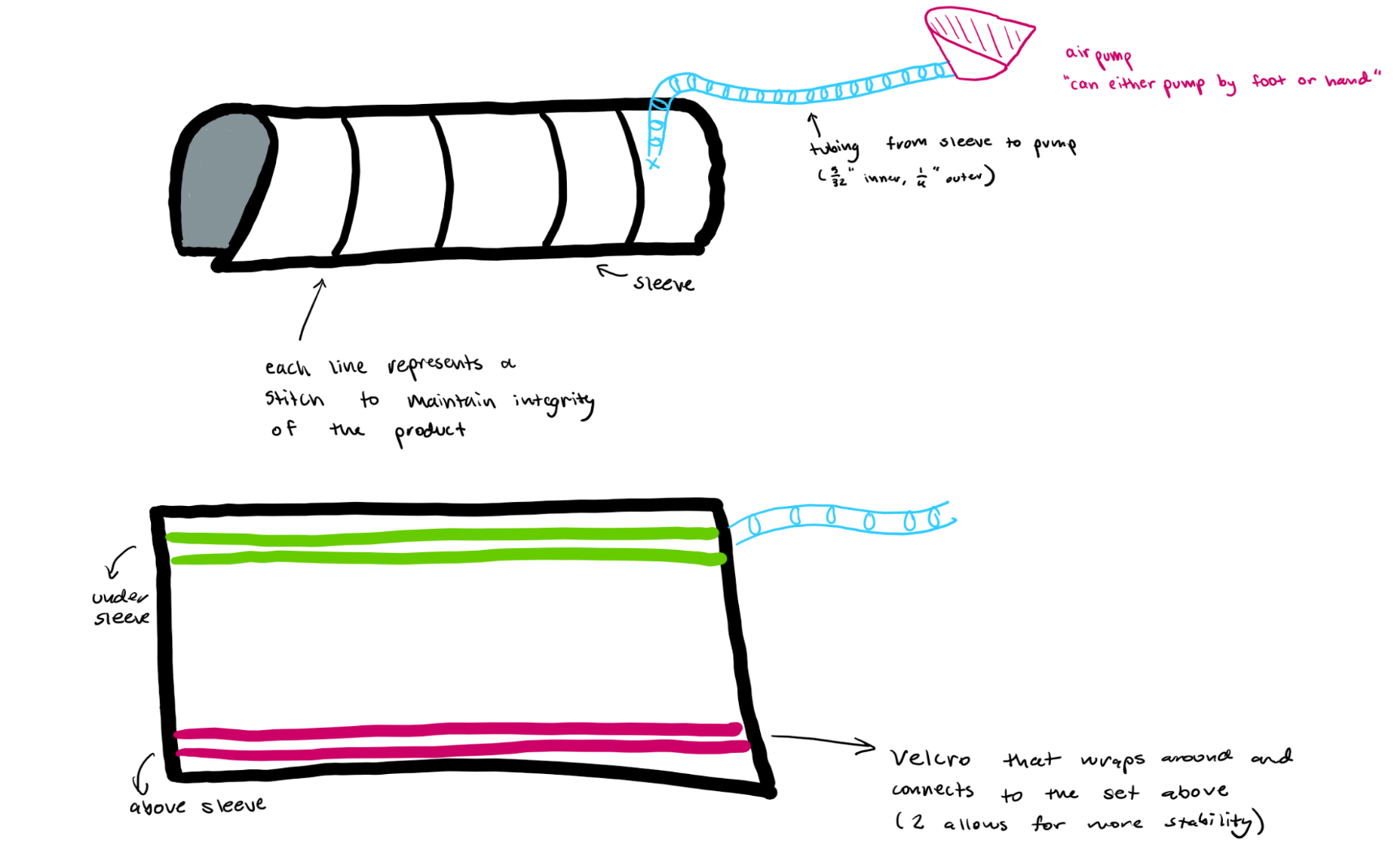
Materials & components
Bladder
Beach ball material, cut and heat-sealed using a hair straightener — airtight, flexible, and conformable to limb geometry.
Pump
Standard foot air pump — available at any hardware or sporting goods store, no modification needed.
Tubing & valves
Standard flexible tubing routing air from pump to bladder, with valves to hold and manually release pressure.
Sleeve structure
Wrap-around sleeve to secure the bladder against the limb with adjustable fastening — no specialized tooling required.
Development photos
Testing
To verify bladder integrity and seal quality, we performed a water bath submersion test — submerging the inflated bladder and checking for air bubbles along the heat-sealed seams under pressure. This gave a clear, immediate pass/fail signal for each seal without requiring any instrumentation.

Design expo
At the end of the semester, our team presented the completed sleeve at the ENGR 0717 design expo — a class-wide showcase where each team demonstrated their device and explained their design decisions to peers and instructors.
Final product

Expo poster

Results
Results and feedback — add notes here.
Key takeaways
- ›Constraint-driven design produces creative, practical solutions — the hair straightener as a heat sealer was discovered through iterating on what was actually available
- ›Heat sealing common plastics is a viable low-cost fabrication technique for low-pressure inflatable bladders
- ›Fully mechanical systems can be more robust and accessible than electronic equivalents for simple actuation tasks in low-resource environments


